
In 1987, veterinary researchers at UC Davis described 21 pet cats with failing hearts, all eating commercial cat food. Each had low blood levels of taurine, an amino acid cats can make only in tiny amounts. In cats given taurine, heart function returned to normal.1 Twelve years earlier, low taurine had been linked to the breakdown of light-sensing cells in the cat's retina.2
What a standard does
Findings like these are what nutrient standards are built from. A standard turns decades of research into a checklist of more than 40 nutrients, and a well-made cat food has to hit every one of them at once. Each nutrient gets a minimum, plus a maximum where too much is a known risk, as with vitamins A and D.
The numbers differ by life stage, since a growing kitten needs more of many nutrients than an adult. They are written per 1,000 kcal (kilocalories, the calories on a food label), because calories decide how much a cat eats. Our recipes follow three standards, each written by a different group for a different job.
NRC: where the numbers start
The National Research Council, part of the US National Academies, published Nutrient Requirements of Dogs and Cats in 2006.3 It is an expert review of the research and sets no rules. For each nutrient it gives a Recommended Allowance (RA), the amount a diet should supply, and where data allow, a Safe Upper Limit (SUL), the highest intake not linked to harm.
NRC is the foundation. AAFCO revised its cat profiles using NRC's allowances, and FEDIAF calculates its adult values from them.
AAFCO: the US benchmark
AAFCO, the Association of American Feed Control Officials, is a nonprofit whose members are government feed control officials. It writes model pet food rules that many states adopt into law, and its Cat Food Nutrient Profiles set the nutrient levels. AAFCO itself never tests, approves or certifies a single bag of food.4
It has two cat profiles: growth and reproduction, covering kittens and pregnant or nursing cats, and adult maintenance. It caps only four nutrients in cat food, including vitamins A and D, and notes that a nutrient without a cap isn't automatically safe at any level.5
FEDIAF: the European guide
FEDIAF is the European pet food industry's own federation. Its guidelines are developed with input from an independent board of nutrition scientists, and the current edition is from 2025.6
It gives adults two sets of numbers. Indoor or neutered cats burn about a quarter fewer calories than active ones, so every calorie they eat has to carry more nutrients. The indoor column asks for more, and our adult recipes use it.
FEDIAF also has two kinds of ceiling: nutritional maximums, the highest levels not linked to harm in research, and EU legal limits on certain vitamins and minerals added as supplements.
Why the numbers differ
Side by side, the three often disagree, as adult protein shows.
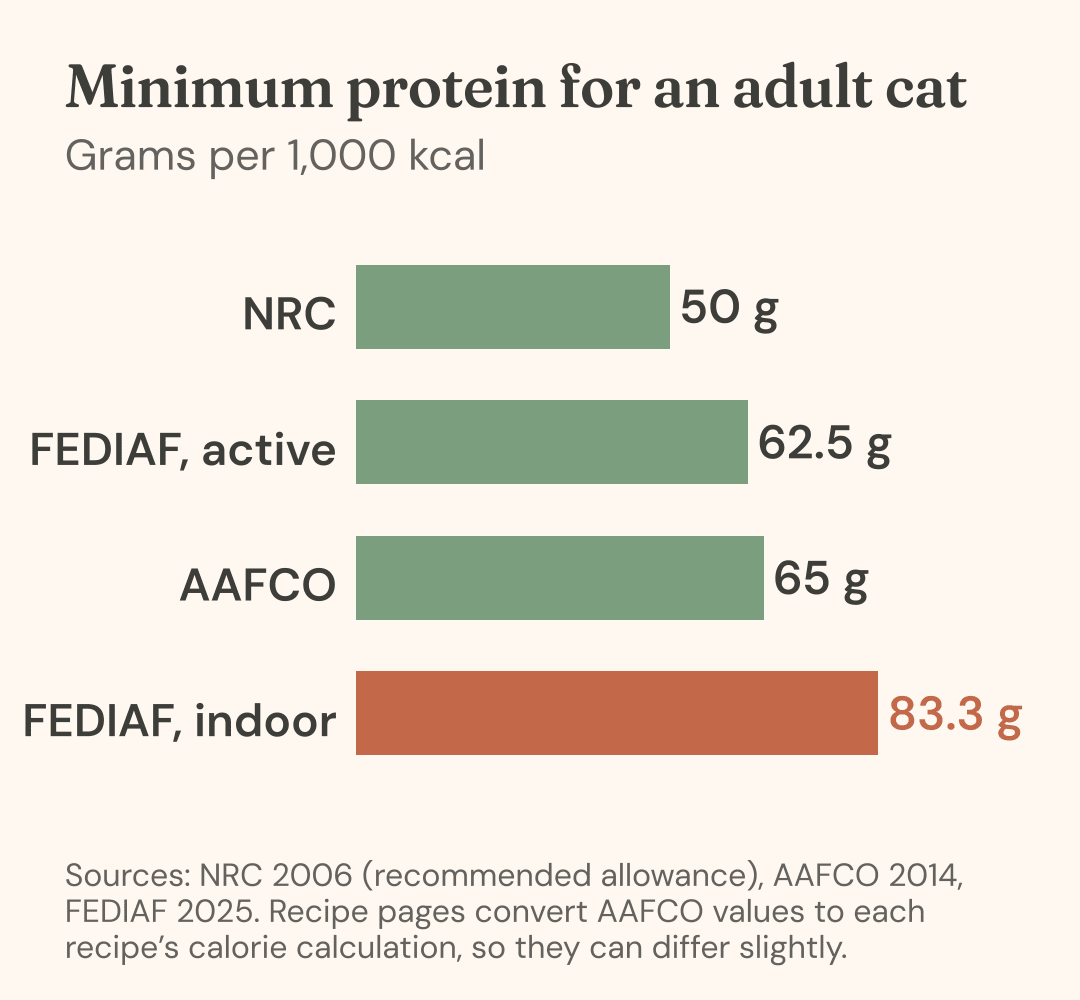
Part of the gap is absorption. Many NRC numbers come from studies with purified lab diets, which show what a cat needs under ideal conditions.5 Real ingredients aren't absorbed as easily, so AAFCO and FEDIAF set many numbers higher. FEDIAF's indoor bar is longest because indoor cats eat less.
No standard is strictest across the board: FEDIAF asks for more protein for indoor adults, while AAFCO asks for more calcium. Each one fills gaps the others leave open.
Meeting all three at once
When we say a recipe follows all three, we mean that for every nutrient it meets the highest of the three minimums. For adult protein, that means clearing the longest bar in the chart above. It also stays within every FEDIAF and AAFCO upper limit that applies. We treat NRC's safe upper limits as advisory guidance.
Our recipes come in two versions. Adults Only is formulated to the adult profiles, for cats 12 months and older. Kitten & Adult meets the kitten growth and adult profiles at once, for homes with a kitten from 8 weeks old. You can see a full analysis against all three standards on the Chicken & Salmon Meal page.
What standards don't cover
Standards are targets for formulation. No organization certifies homemade recipes, and ours are formulated by calculation from nutrient data. Their numbers are set for healthy cats.
References
-
Pion PD, Kittleson MD, Rogers QR, Morris JG. "Myocardial failure in cats associated with low plasma taurine: a reversible cardiomyopathy." Science. 1987;237(4816)
. ↩ -
Hayes KC, Carey RE, Schmidt SY. "Retinal degeneration associated with taurine deficiency in the cat." Science. 1975;188(4191)
. ↩ -
National Research Council. Nutrient Requirements of Dogs and Cats. Washington, DC: National Academies Press; 2006. ↩
-
AAFCO. "Understanding Pet Food." aafco.org. Accessed November 2026. ↩
-
AAFCO. Dog and Cat Food Nutrient Profiles (Appendix A). 2014. ↩ ↩2
-
FEDIAF. Nutritional Guidelines for Complete and Complementary Pet Food for Cats and Dogs. September 2025. ↩


